
MalwareScope

LLM-assisted malware analysis and classification

A self-hosted platform that tells you what a Windows file is, then proves what it does, without the file ever leaving the organisation.

Presented by
Omar Kharrat
Rayen Skhiri
Supervisors
Hachem Barhoumi, 3S
Sourour Mhenni, ISI
Graduation project
National Professional Master's
Information Systems and Infrastructure Security, 2025-2026
Standard Sharing Software (3S)Institut Supérieur d'Informatique

Our host: the Cybersecurity department of 3S

An integrator since 1988

Standard Sharing Software builds and runs IT infrastructure for companies in Tunisia, and in Côte d'Ivoire since 2019.

Security is a core business

Firewalls, SIEM, IAM and PAM, and a SOC and NOC that watch customers' systems.

TrustShield, the managed SOC

Built with GlobalNet on an XDR, a SIEM and a SOAR. The technology partners are Palo Alto Networks and Splunk.

That is why MalwareScope plugs into Cortex XDR and Splunk: they are the tools the SOC already uses every day.
A suspicious file reaches the SOC. What is it, and what does it do?

AV-TEST registers more than 450,000 new malicious programs every day. Most are variants built to slip past signatures.

Usual answerWhy it falls short
Reverse engineering by handReliable, but one analyst cannot keep up with the volume.
Antivirus verdictSignatures and opaque heuristics: hard to explain, easy to evade with a new variant.
Public sandboxThe customer's file is uploaded to a third party.
Self-hosted sandboxHeavy to set up, and if it is badly isolated it becomes an attack path itself.
Ask a general LLMTempting, but in our test it was right only 36% of the time.

Meet MalwareScope

Drop a Windows file. Get its family in seconds, watch it run in a sealed machine, and send the verdict back to the incident. On your own hardware.

2independent verdicts, static and dynamic
21.9 sfrom the request to a running sample
0files sent outside the organisation
Live sandbox session with a 100 out of 100 verdict

One workspace · 1 / 3

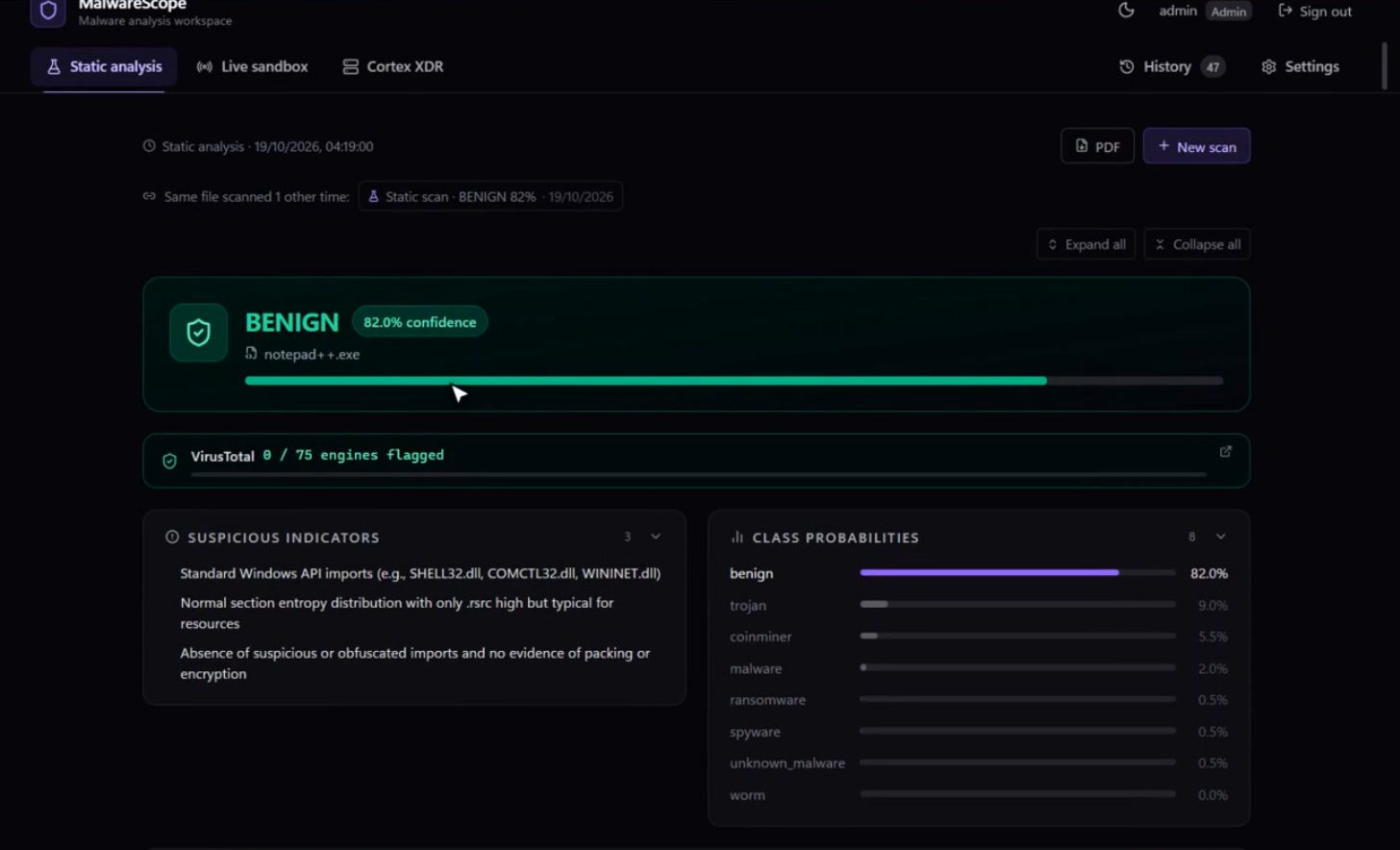
A verdict in seconds, then the real behaviour

Static verdictfamily and confidence in seconds, with a written explanation
Live sandboxdrive the Windows desktop from the browser

One workspace · 2 / 3

Every finding explained, every indicator ready to share

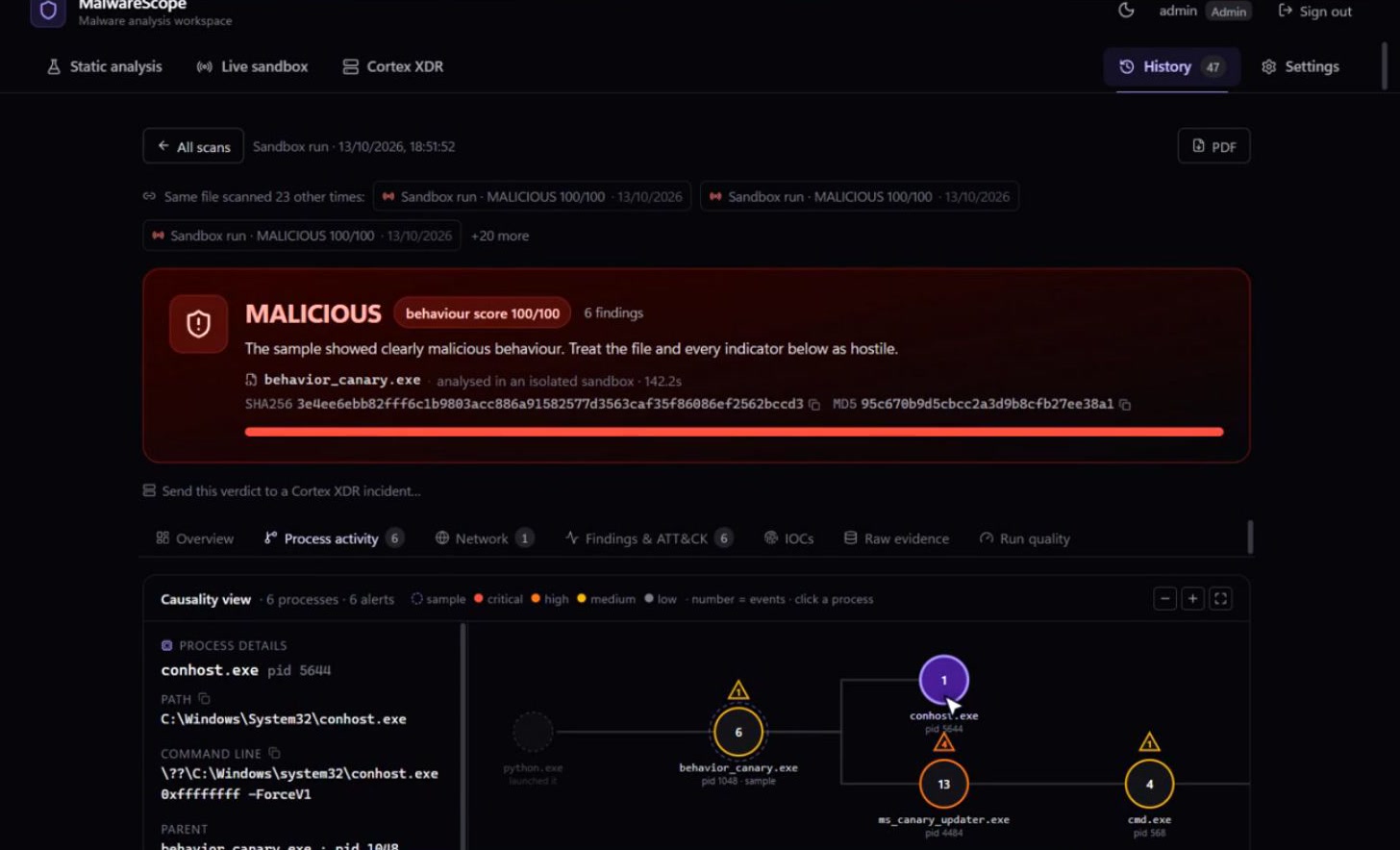
Causality graphevery finding tied to the process that caused it
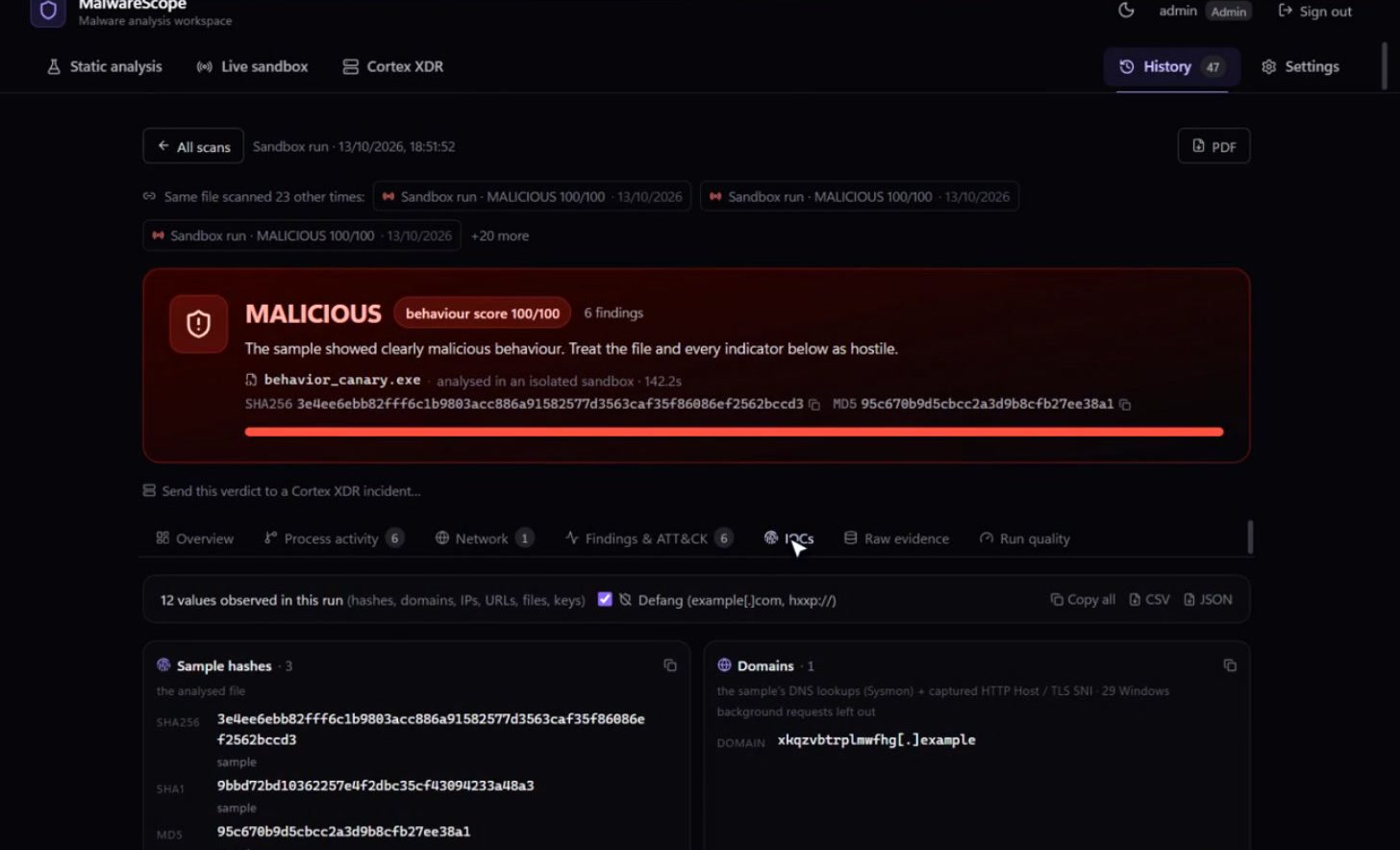
IOCs ready to sharehashes, domains, URLs, defanged, CSV or JSON

One workspace · 3 / 3

Kept as proof, and wired into the SOC

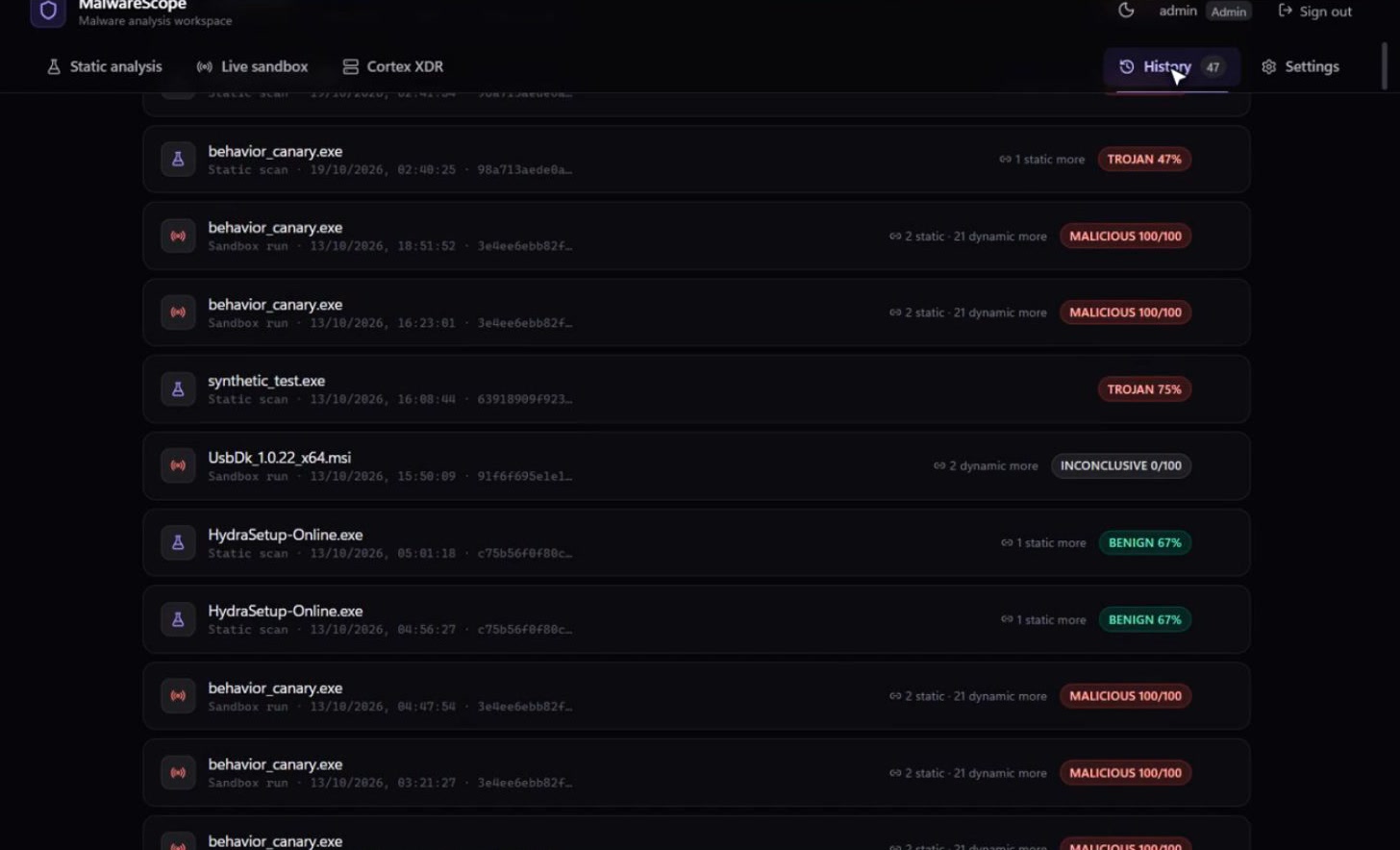
Signed historyPDF report and an integrity check for each analysis
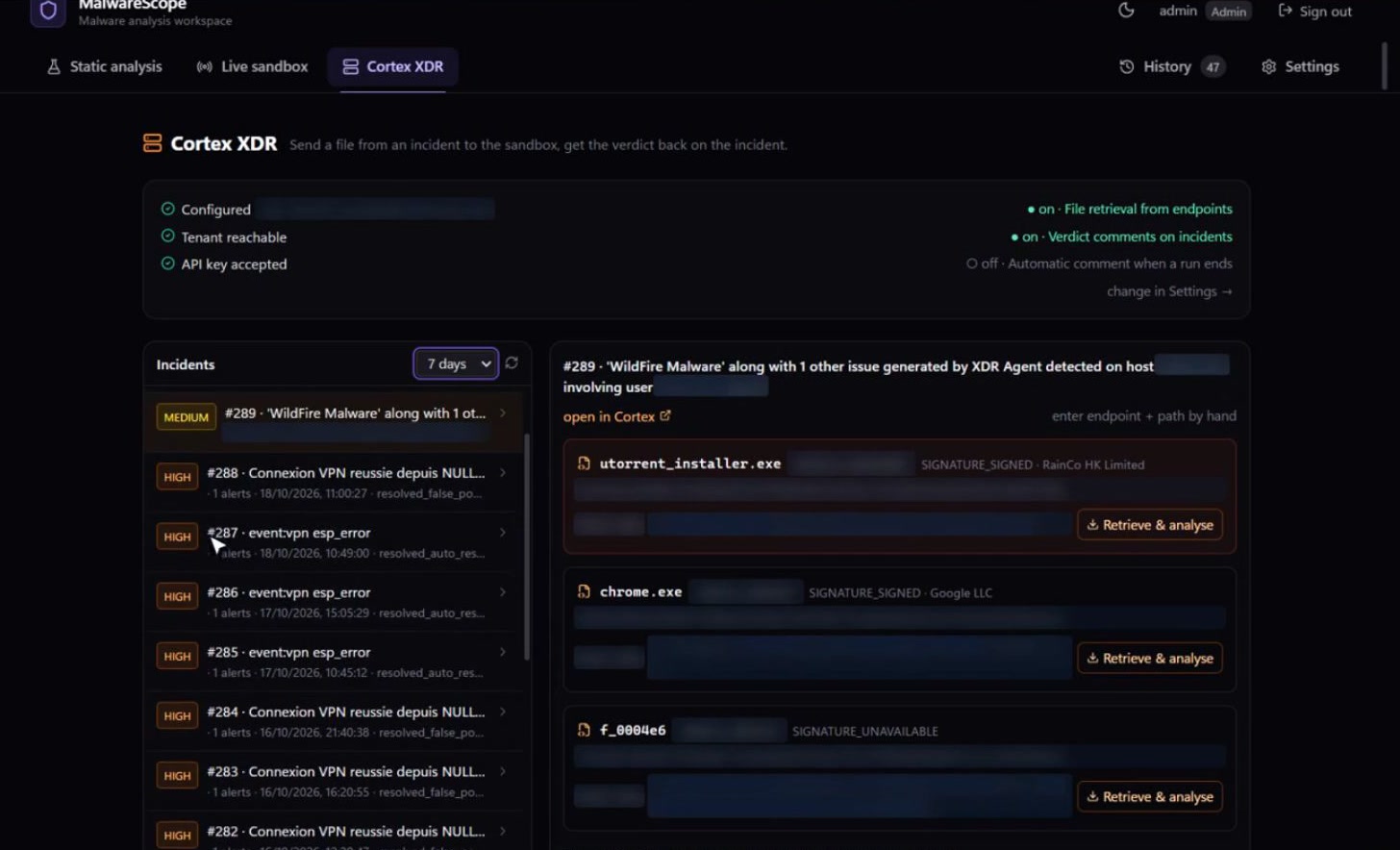
Cortex XDR tabfrom an incident's file to a verdict on the incident

How it works: two verdicts on the same file

One Windows executable, identified by its SHA-256, never run outside the sandbox

Static verdict

a few seconds, the file is never executed
8 features read from the PE structuresize, entropy, sections, imports, exports, strings
Random Forest we trained on 760 real files
Family and confidence for example trojan, 82%

Dynamic verdict

the file runs in a disposable Windows VM
Isolated KVM machine, live console in the browser
Sysmon telemetry and full network captureDNS, decrypted HTTPS, PCAP
Behaviour score from 0 to 100 with MITRE ATT&CK techniques

The language model never gives a verdict. It writes the explanation of both, in plain English.

A model we trained ourselves, on 760 real executables

trojan319 benign201 ransomware110 spyware51 malware (other)49 coinminer25 worm3

Plus 2 files of unknown family. The set is imbalanced, and that shows in the results.

559 real malware

AgentTesla, Emotet, GandCrab, LokiBot, NanoCore, TrickBot and others, from three public research repositories: jstrosch/malware-samples, theZoo and MalwareBazaar.

The 201 benign files are real tools: Sysinternals, PuTTY, 7-Zip, Notepad++.

Samples stay in encrypted archives and are never pushed to Git.

Eight features, and the model that fits them

FeatureWhat it tells us
file_sizepacked payloads are often large
file_entropyabove 7, likely compressed or encrypted
num_sectionsunusual counts point to a packer
avg_section_entropywhere the packed data sits
num_imported_dllswhich Windows libraries it needs
num_imported_functionsfew imports: API resolved at run time
num_exportsfunctions it offers to others
strings_countreadable strings of 5+ characters

Why a Random Forest

Random Forest chosen

200 trees vote. Good results with default settings on a small set, no scaling needed, a real confidence and the weight of each feature.

XGBoost

Strong on millions of files like EMBER. On 760 files it overfits unless it is finely tuned.

k-nearest neighbours

Distance based: the file size in millions of bytes drowns out entropy. No feature importance.

On 152 files it had never seen

89.5%

accuracy over the seven families
weighted F1 0.87

95.4%

benign or malicious
2 false positives, 5 misses

86.8%

mean of a 5-fold cross-validation
84.9% to 88.8% per fold

Ransomware and coinminers are almost perfect. Most errors land in the mixed "malware" class and the rare worm, which the model calls trojan.

With 60 training files the model scores 79.6%, with 608 it reaches 89.5%, and the curve is still rising. Re-running the training script gives exactly the same numbers.

Most useful features: file entropy (0.169), imported functions (0.163), strings (0.138).

Could an LLM alone do the job? We measured it

Same 50 real test files, same information. The LLM (gpt-oss-20b through Groq) had to name the family by itself.

82%

our Random Forest

36%

LLM alone

On the yes-or-no question, the LLM caught almost every malware. It also called all 13 benign files malicious.

A tool that flags every clean file buries the analysts in false alerts. The forest kept 12 of the 13 clean files clean.

So in MalwareScope the trained model decides, and the LLM writes the explanation from the same evidence.

The sandbox never runs a file it cannot watch

  1. Check the cage
    the VM sits on a network with no route out, nothing is shared
  2. Test the recorders
    the guest makes a marker process and a DNS query with a random nonce
  3. Find the proof
    the host looks for that nonce in Sysmon, in the DNS sink and inside the PCAP
  4. Deliver, verify, wait
    the file lands on the desktop, SHA-256 checked on both sides, not executed
  5. Run on command
    only when the analyst presses Run

Capture service stopped on purpose: the run is refused in 0.5 s and the VM never starts.

A live Windows desktop in the browser, like ANY.RUN, but at home

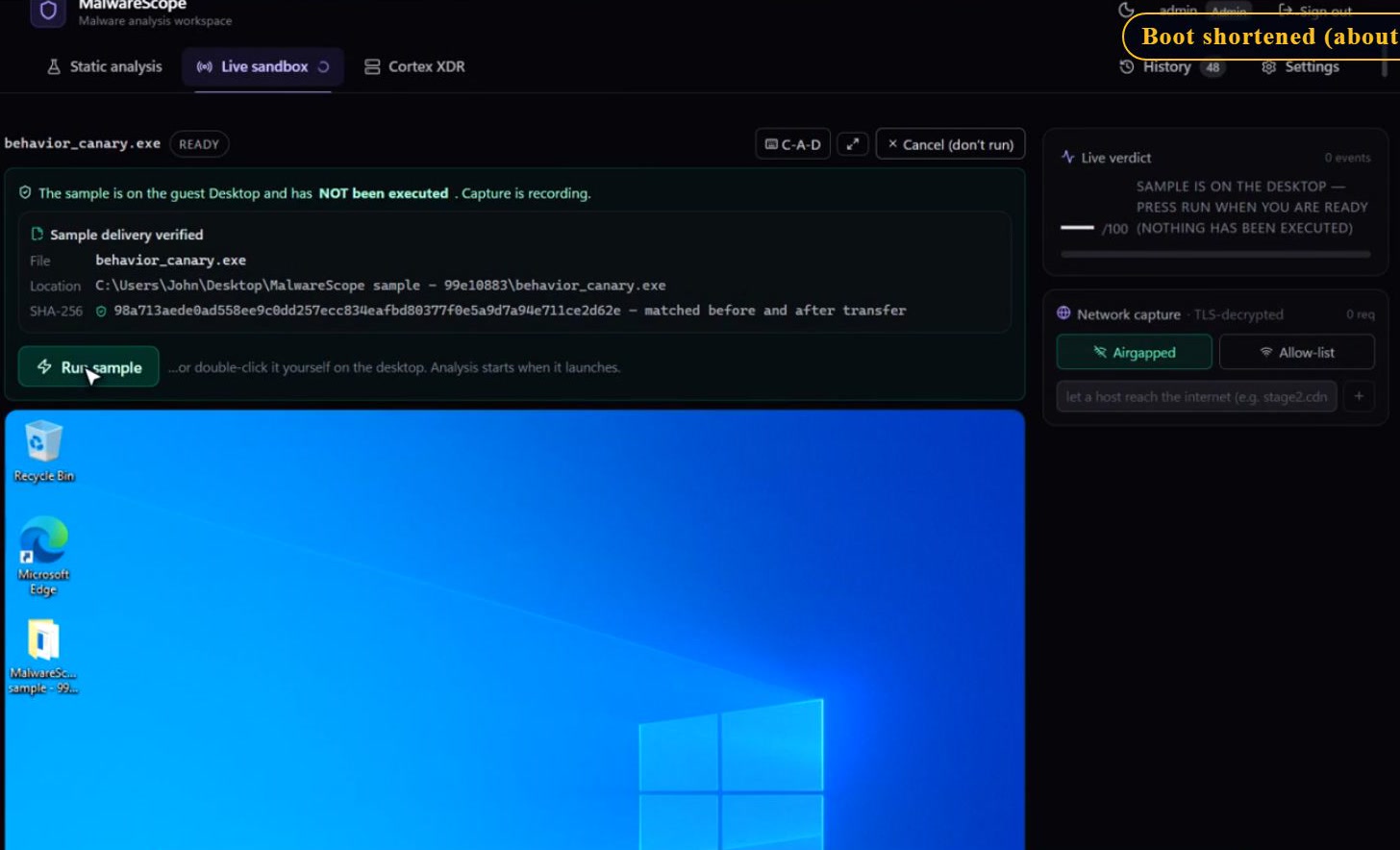
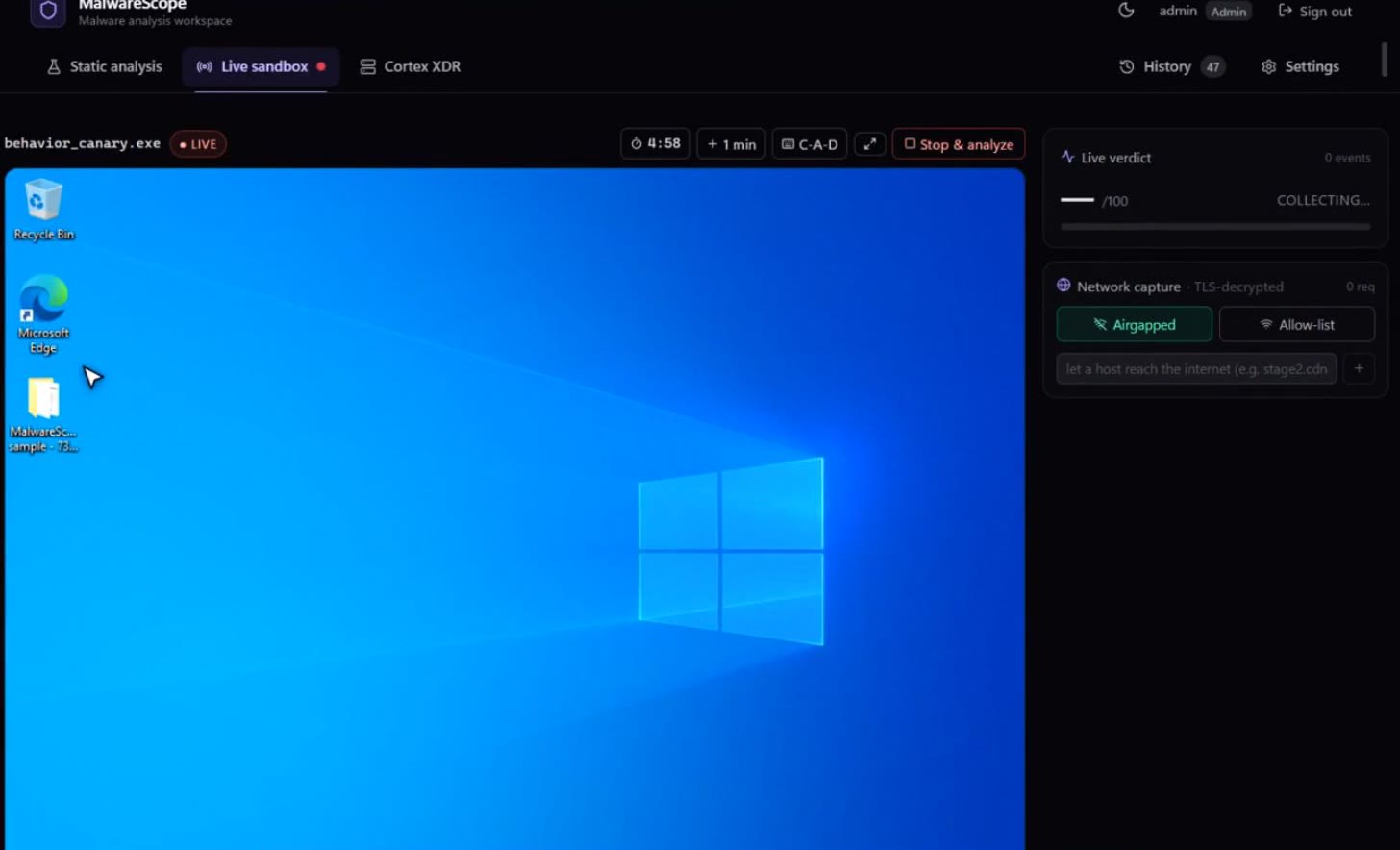
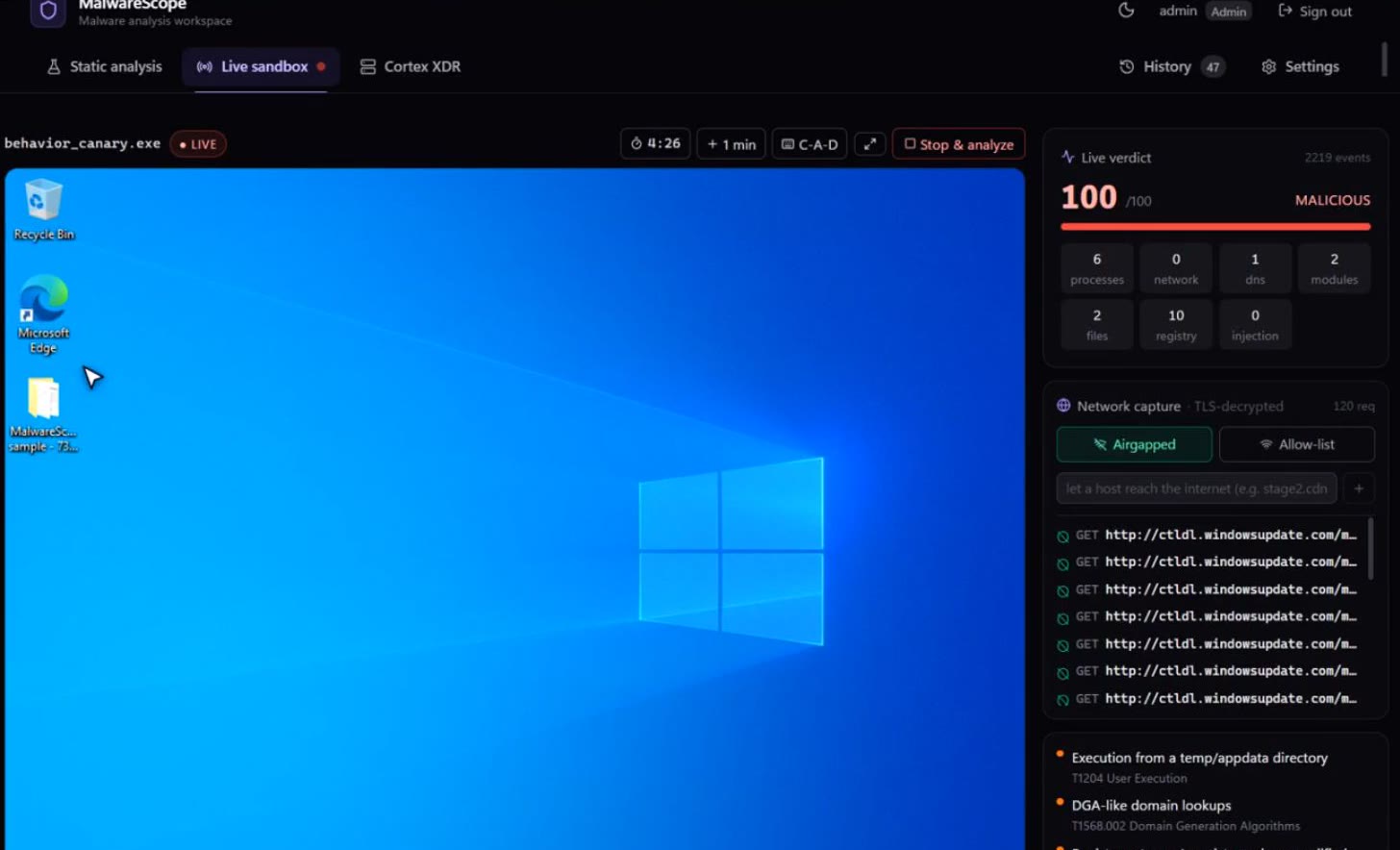
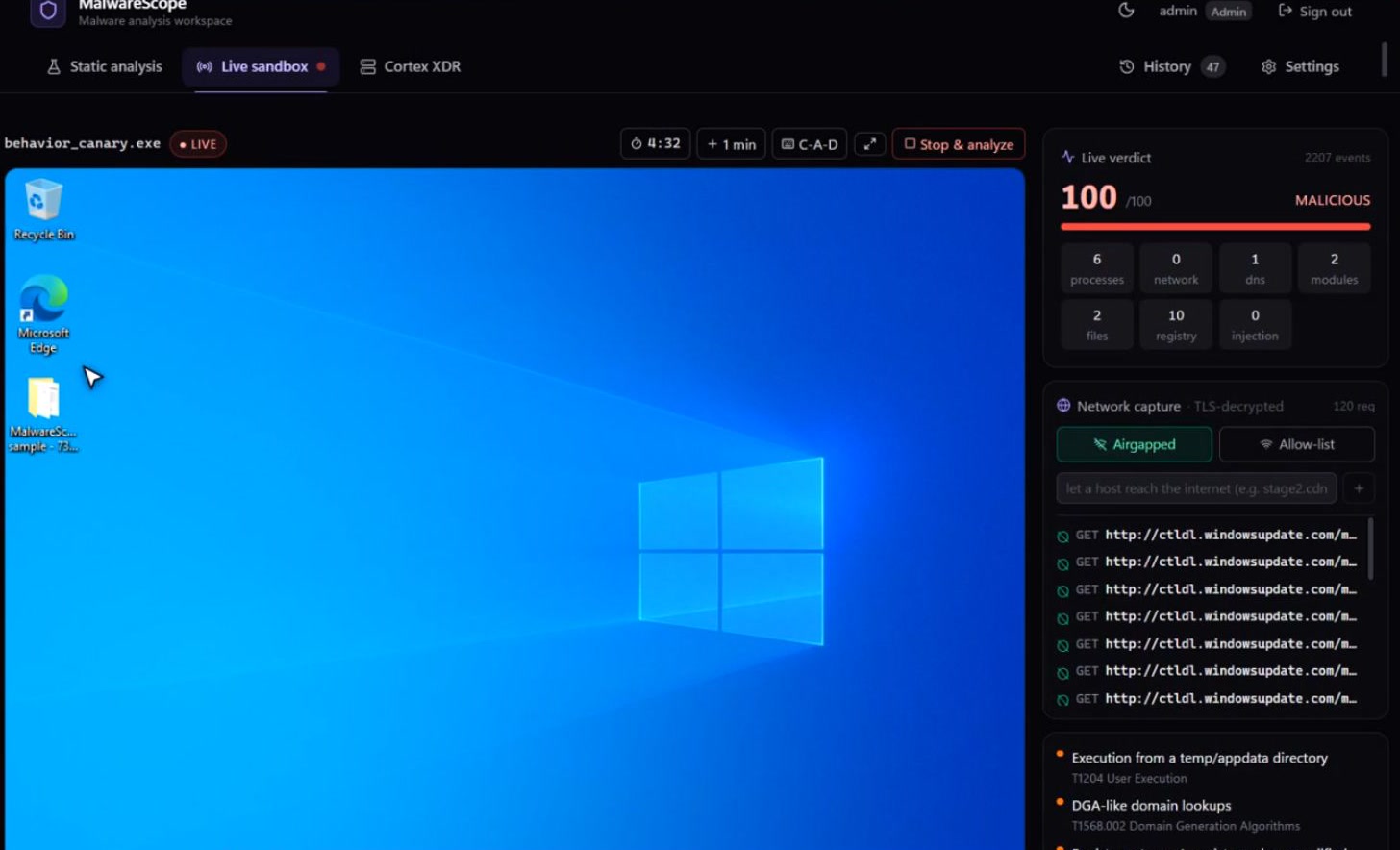
Real session with our harmless test program, the canary. Played at 1.5x.

The analyst drives the VM through a filtered noVNC console. Verdict, decrypted requests and findings fill in while the sample runs.

69.2 s → 21.9 s

from the request to a running sample, thanks to warm start: a saved, logged-in Windows desktop restored on a fresh disk overlay

40 warm-start sessions out of 40 completed.

Live sandbox · one run

One run, three moments

01Delivered, not executedon the guest desktop, SHA-256 matched before and after transfer, capture already recording
02Runningthe analyst pressed Run: the live verdict and the network capture start filling in
03Verdict100 / 100, malicious, from 2,219 events, findings mapped to MITRE ATT&CK

One appliance, and every part only gets what it needs

Appliance host, Ubuntu Server 24.04 Analyst browser React app, noVNC Web service (API + interface) no privileges, hardened systemd static analysis, sessions and pool isolation gate, VNC filter signed history, audit, settings Cortex XDR and SIEM connectors Capture service root, one per machine DNS sink TLS proxy (mitmproxy) PCAP, kill switch libvirt + QEMU confined per VM own user AppArmor + seccomp policy file in, flows out local libvirt socket only Isolated networks: no forward, no NAT, no route out Analysis machine 1 Windows 10, Sysmon, 10.200.0.0/24 Analysis machine 2 Windows 10, Sysmon, 10.201.0.0/24 DNS, HTTP, HTTPS redirected guest agent

Least privilege. The part exposed to the network has no rights. Only the capture service touches iptables and tcpdump.

One channel to the guest. Files and commands go through the QEMU agent. No shared folder, no clipboard.

One machine per analysis. Each slot has its own network, capture and image, and is destroyed after use.

Twelve layers, each assuming the last one can fail

Contain the sample

so it cannot reach the host or the Internet

L1 QEMU confinementown user, AppArmor, seccompread on the running VMs
L2 Network isolationgate refuses any routed or bridged VM11 tests, ISOLATED OK
L3 Controlled egresssink by default, allow-list, kill switchsink active on every run

Observe correctly

so the sample shows its real behaviour

L4 Anti-evasionhypervisor flag hidden, Dell SMBIOS, real MACPafish: 3 markers gone
L5 Controlled executionverified delivery, one use, clean state provenrefusal in 0.5 s
L6 Untrusted guest dataallow-listed keys, size capsautomated tests

Protect access

so the platform itself is not the way in

L7 Hardened servicesystemd sandbox, no capabilitiesexposure 9.2 → 1.5 / 10
L8 AuthenticationPBKDF2, HMAC tokens, rolesblocked from the 11th try
L9 Web and consolestrict CSP, single-use 30 s ticket, RFB filter11 tests

Prove

so a result can be trusted later

L10 Secretsgenerated on the box, encrypted, write-onlybundle refused with a key
L11 Evidence and auditSHA-256 + HMAC manifest per analysistampering detected
L12 Confidentialitythe file never leaves, Cortex writes off by defaultno secret in API replies

From a Cortex XDR incident to a verdict, inside the SOC

What an analyst does today

  1. an XDR alert flags a file on an endpoint
  2. someone fetches the file by hand
  3. uploads it to a public sandbox, or pays for ANY.RUN through XSOAR
  4. copies the result back into the incident

With MalwareScope

  1. pick the incident and the file in our Cortex tab
  2. the endpoint's agent uploads the file after an explicit confirmation
  3. it runs in our own sandbox, on our own network
  4. the verdict goes back as a comment on the incident

No XSOAR licence, no third-party upload, and every step stays in the audit log.

The loop, call by call, on the Cortex XDR public API

  1. List incidents incidents/get_incidents
    severity, alerts, status, last 7 days by default
  2. Files and endpoints of an incident get_incident_extra_data
    name, hash, signature, where it was seen
  3. Retrieve the file endpoints/file_retrieval
    confirmed by the analyst, then followed with get_action_status
  4. Unpack safely
    size caps, no path tricks, SHA-256 must match the incident
  5. Analyse
    a normal sandbox session, Run stays manual
  6. Post the verdict incidents/update_incident
    score, family, link to the PDF report

The two writes are off by default

File retrieval and the verdict comment touch customers' endpoints and incidents. An administrator turns them on in Settings, with a warning, and each use is audited.

What the client cannot do

There is no isolate, quarantine or remediation function in the code. The API key only needs the "Privileged Responder" role.

Connected to a real Cortex XDR tenant

Customer names, hosts, users and the tenant address are blurred. The incidents and files are real.

Configured, tenant reachable, API key accepted. The tab lists the real incidents of the last seven days, their files with the signature status, and the endpoints where each file was seen.

Where we stand

done on the real tenant
reading incidents, files and endpoints

validated on a simulated tenant
file retrieval and the verdict comment, end to end, with automated tests

Cortex can call us too, and the whole SOC gets the results

MalwareScope as a Cortex integration

Packaged as one YAML file, like the ANY.RUN pack, so a playbook can call our sandbox.

malwarescope-detonate-filesubmit and poll for the verdict
malwarescope-get-analysisfull result
malwarescope-get-report-pdfattach the report
malwarescope-lookup-hashknown verdict for a SHA-256

Tested against our real API: the canary came back malicious, 100/100, in 110 s. Importing it in a SaaS tenant needs a Cortex engine that can reach the appliance.

Exports to the tools around it

Splunk

HTTP Event Collector

Any SIEM

CEF over syslog

Threat intel

STIX 2.1 / TAXII, MISP

Chat, tickets

signed webhooks

Only malicious results are published as indicators, with an expiry and without private addresses. VirusTotal only ever receives the hash.

What TrustShield and its analysts get from it

For the managed SOC service

  • A sandbox of its own. Customer files are analysed inside the SOC, never uploaded to a public service.
  • It speaks the stack TrustShield sells. Cortex XDR in, Splunk out, with the same Palo Alto Networks and Splunk partners.
  • Evidence to hand to a customer. A signed PDF report, the IOCs and the packet capture for every analysis.
  • Easy to roll out. One ISO and about thirty minutes, on a central box or at a customer's site.

For the analyst on shift

  • A first answer in seconds, then the real behaviour about twenty seconds after pressing Run.
  • No copy and paste. The file comes from the endpoint and the verdict goes back onto the incident.
  • Findings they can defend. Each one names the process behind it and its ATT&CK technique.
  • No false comfort. When the capture cannot prove a file is clean, the answer is inconclusive.

How it compares with what SOCs use today

VirusTotalHybrid AnalysisANY.RUNCuckoo / CAPEMalwareScope
Where the file goespublic cloudpublic cloudvendor cloudstays on sitestays on site
Static verdictmany AV enginesstatic analysisdynamic onlyno static modelour trained model
Live, interactive VMnonoyesmostly automatedyes
Refuses to run until the capture is provennonononoyes
Cortex XDRnot compared herethrough XSOARnobuilt in, no XSOAR
Getting startednothing to install, private analysis is paidheavy installationISO, about 30 min

From the public descriptions of each product, as summarised in chapter 2 of our report. MalwareScope is smaller in scale: one Windows image, and no API call tracing yet.

What is new in MalwareScope

Capture before execution

The sample only runs once the host has found its own test traffic in Sysmon, the DNS sink and the PCAP. No proof, no run.

Verdicts that admit doubt

A clean result the evidence cannot support becomes inconclusive. What is not collected, like API calls, is shown as not collected.

An LLM in the right job

We measured it against our trained model, 36% against 82%, so it explains the verdict and never gives it.

Cortex XDR without XSOAR

From an incident's file to a verdict on that incident, with endpoint actions off until an administrator turns them on.

Proof you can check later

Every analysis carries a SHA-256 and HMAC manifest, so a changed verdict or screenshot is detected.

A sandbox you can install

An ISO that builds its own Windows analysis machine and checks its isolation before the first run.

It installs like an appliance, and it is tested

30 min

from booting our ISO to a working appliance, analysis machine included, on a fresh 6-core VM

413

automated tests, no failure, run on the appliance with fake guests and a fake libvirt

40 / 40

warm-start sessions completed, 12 / 12 with the final manual policy, 9 / 9 with two at once

Docker was considered and dropped: the web part uses 30 MB, each Windows machine about 3 GB, and a container would need the libvirt socket and network admin rights anyway.

The two verdicts complement each other

FileStatic (RF)Dynamic (sandbox)What we learn
canary (imitates malware)trojan, 45.5%malicious, 21 runs at 100/100the model hesitates on an unusual file, the behaviour settles it
benign test programtrojan, 48.5%benign, 14/100a low-confidence static mistake, fixed by the sandbox
Python installernot analysedsuspicious, 52/100installers drop executables from Temp, like droppers
Zadig (USB tool)trojan, 38%inconclusivenothing observable, so no false "benign"
UsbDk driver (.msi)not analysedinconclusivenot an executable, reported as such

What is still missing, and what comes next

Limits we know

  • 760 files, imbalanced, labelled by family
  • sandbox measured with our canary, not yet a batch of real malware
  • rules are harsh on installers
  • Windows API calls are not collected
  • Cortex writes not yet run on a real tenant; HTTP only

Next steps

  • run a batch of real malware and compare RF, LLM and sandbox on it
  • one hybrid model on static and behavioural features
  • use Authenticode signatures in the score
  • the full Cortex loop on a test endpoint, then the playbook pack
  • HTTPS in the setup wizard, rename Sysmon, remove the last QEMU markers
  • implement MFA (multi-factor authentication) in the application

Know what a file is. Prove what it does. Keep it at home.

89.5%

static accuracy

82 vs 36

our model vs an LLM alone

21.9 s

to a running sample

12

defence layers

MalwareScope

Thank you
for your attention.

We are happy to take your questions.

Presented by
Omar Kharrat
Rayen Skhiri
Supervisors
Hachem Barhoumi, 3S
Sourour Mhenni, ISI
Standard Sharing Software (3S)Institut Supérieur d'Informatique